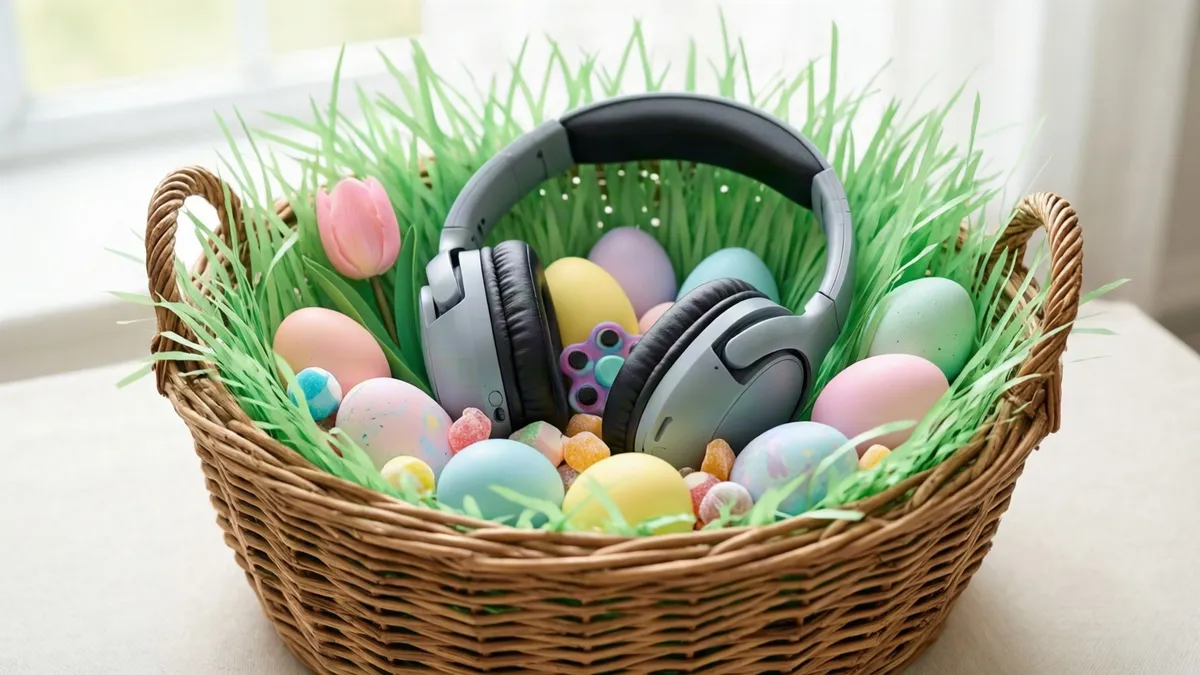
The short answer: Build a teen boy's Easter basket around one anchor item that matches what he's into right now, then let candy and small stuff be filler. A $20 anchor beats $60 of assorted filler, because the anchor is what he'll use and remember. Below: how to find it, what to spend, and how to arrange the basket so he actually notices.
We write buying guides, not reviews: we have not used every item on this page. Specs come from the manufacturer or the listing, and whatever Amazon shows when you click is the authoritative figure.
The Federal Trade Commission's endorsement guides, 16 CFR Part 255, require a disclosure like that one to be difficult to miss, so it sits above every link here. Our full affiliate disclosure has the rest.
Written by the editorial team behind this site — gift researchers who compile buying guides from public sources, manufacturer specs, and customer reviews rather than hands-on product testing.
Easter Sunday falls on March 28 in 2027, which is a longer runway than some years; the full date logic lives in When Is Easter? Dates Through 2032 and Why It Moves. Check the date, work backwards to shipping cutoffs, then buy the anchor first. For the framework across every age, see Easter Basket Ideas, Sorted by Who It's For — this page is the teen-boy slice of it.
For some families reading this, Easter is a religious holiday; for others, it's a spring tradition. The basket belongs to both. A teen boy's basket just belongs to a different conversation than a toddler's, and that conversation starts with one item.
Easter Basket Ideas for Teen Boys Start With One Item
Teen boys are hard to buy for, and the reason is specific. Their interests change fast, they don't fake enthusiasm, and a basket of assorted filler reads as effort without attention. He clearly craves attention this month.
That's the anchor rule. Pick one thing he'll actually use, spend real money on it, and let everything else be cheap. The filler disappears by April; the anchor is what he keeps.
The five-layer structure behind every basket lives in What to Put in an Easter Basket: The Five Layers. For a teen, three of those layers shrink and the anchor grows. The vessel barely matters, the filler matters less, and the anchor is the whole message: I know what you're into.
Finding the Anchor: A Five-Step Interest Check
Skip the guessing. Ten minutes of observation beats an hour of scrolling a gift guide, because the anchor has to match this month's obsession, not last year's. Our suggested version of the check:
- Watch what he does unprompted for a week, not what he says he likes. The two rarely match at this age.
- Look at what he already uses daily. The anchor upgrades a habit instead of starting one.
- Ask a sibling or a friend what he's been saving for. They know; they just haven't told you.
- Check whether a wishlist exists on his device. It isn't cheating, it's research.
- Pick the item he'd never spend his own money on but would use constantly. That gap is where good gifts live.
Then fill in the template: "He's into most right now. The version of that he'd use weekly is . I'll spend ___ on it." Shop to that sentence, not to the aisle.
| Interest | The anchor (our pick) | Band (ours) | Why it works (ours) |
|---|---|---|---|
| Gamer | A headset or controller upgrade for the setup he already has | $25–$40 | Upgrades a habit he runs daily, so it gets used and remembered |
| Sports | A quality ball or a disc golf starter set | $20–$35 | Fits the season; in use the same afternoon |
| Music | Decent earbuds or band merch he wouldn't buy himself | $20–$40 | Proves you noticed what's on repeat |
| Books | The next hardcover in the series he's mid-way through | $15–$25 | A series he's invested in is a guaranteed read |
| Outdoors | A hammock or camping lantern | $20–$35 | One real gear item beats a pile of novelty gadgets |
| Multiplayer | A party card game the whole table can play | $10–$20 | Gets used with friends, which is the point at this age |
Our take: Spend on the anchor and keep the filler almost free. Our call is a $20-to-$40 anchor for most teen boys, with the gamer as the standing exception: the setup already exists there, so a smaller accessory outperforms a big-ticket item. For a boy with no fixed hobby yet, the multiplayer pick is the safest anchor because it gets used with other people.
Filler: Candy, Snacks, and Small Stuff
The filler is cheap on purpose. Two or three favorite candies, a bag of jerky or trail mix, and a fidget pack are great options. Add a pair of fun socks and a slim portable charger to cover the practical-and-fun mix without touching the anchor's budget. A grooming kit or body spray belongs here too, because teens use it and rarely buy it.
One safety note settles a real decision if younger kids are around. The CPSC's toy safety guidance, dated 2026, says to keep small balls and toys with small parts away from children younger than age 3. A fidget set or a card game with tiny pieces belongs in a teen basket, but it lives up high, out of a toddler's reach. The same agency's rules require toys that pose a choking hazard for children under 3 to carry an age label, so the box tells you before you buy.
Packaging labels follow federal rules, and the FTC's Fair Packaging and Labeling Act regulations are part of why the ingredient and quantity lines exist on every bag of candy. Read them. Smaller filler ideas by age sit in Easter Basket Stuffers: Small Fillers by Age Band.
A Real Budget for a Teen Boy's Easter Basket
Across the three ranking guides we compared, prices mentioned run roughly $5 to $40 with a median around $15 — our computation from 17 price mentions, not a survey. Read that as confirmation that filler should be cheap, not as a spending rule.
Our bands, not a sourced figure: $30 to $45 total works for most families. Two-thirds goes to the anchor, the rest to candy and small stuff. Under $25 is doable when the anchor is a book or a card game. Past $60, you are usually buying filler to justify the basket.
The National Retail Federation publishes Easter spending data each year, and the figures move with the season. We'd rather hand you bands you can act on than a number that expires. If you're building the vessel itself, How to Make an Easter Basket: Steps and Real Budget walks the container math.
Arranging the Basket So He Actually Looks
Anchor on top. Always. If the one thing he cares about is buried under grass and crinkle paper, the basket reads as candy plus noise, and the message is lost.
Skip the plastic grass. It sheds, it ends up behind the couch, and no teen has ever been impressed by it. Shredded paper, a folded T-shirt, or nothing at all does the job.
The vessel can be the upgrade. A small storage crate, a laundry basket he'll actually keep, or a duffel turns the container into part of the gift. Scatter the candy around the anchor's base so the shape still reads as a basket, and skip the cellophane if he's over thirteen; he'll tear through it in four seconds either way.
No Candy, No Problem: Eco and Non-Candy Anchors
The anchor rule doesn't care whether candy exists. Reuse last year's vessel, swap grass for paper shred, and the basket is already most of the way to low-waste. If you decorate with balloons anyway, the same CPSC page says deflated balloons stay away from children under 8.
Non-candy anchors that hold a basket on their own: a sketchbook set for the drawer-and-doodle type, a journal, a car wash kit for the boy with a key now, a phone case or a wallet. Snacks that aren't candy, like jerky or trail mix, carry the flavor layer instead.
If allergies are in the picture, peanuts and tree nuts are the ones that come up, and the label carries the allergen statement. The call is yours; we stop at the label. More builds like this live in Non-Candy Easter Basket Ideas That Actually Land.
The Experience Basket: Gifts That Aren't Things
An experience is the ultimate anchor, because it can't be re-gifted, lost in a drawer, or compared against anyone else's basket. A climbing gym session, a driving range booking, movie tickets, a lesson in the thing he's been circling: all of it wraps flat.
Wrap it honestly. Print the confirmation, fold it into an envelope or a large plastic egg, and put it on top where the anchor would sit. The candy and small stuff become the supporting cast around a plan.
An experience anchor also trades a screen for an afternoon out of the house. The American Academy of Pediatrics' screen time guidelines leave screen limits to each family, so match the gift to your house's rules rather than to a general principle.
FAQ: The Questions Parents Actually Ask
What's a cheap or DIY Easter basket for a teen boy?
Use a storage crate, a small toolbox, or a dollar-store vessel he'll keep, then put nearly everything into one $15-ish anchor. Grocery-aisle candy covers the filler. Under $25 total is a realistic build.
How much candy belongs in a teen boy's basket?
Two or three favorites, not a bag. The candy layer exists to make the basket look full and to be eaten first; it was never the point. Post-Easter sales restock it cheap if you're planning a year ahead.
What if he has food allergies?
Read the allergen statement on every package, and skip bulk bins where cross-contact is untracked. A non-food anchor means the basket still stands even if you pull every snack from it.
Is a teen boy too old for an Easter basket?
No, but the vessel should age with him. A grass-lined basket reads young at fourteen; a crate, a duffel, or a tackle box reads fine. Scale the anchor up instead of adding more filler.
Should I just ask him what he wants?
Asking guarantees use and kills the surprise, and at this age the surprise was never worth much. A middle path: ask one friend or sibling, or check the wishlist quietly. Either way you're still running the interest check, just with help.
Jenny Albright writes buying guides, not reviews; nothing here was tested by us.
Sources
- National Retail Federation — "Easter | NRF" (https://nrf.com/research-insights/holiday-data-and-trends/easter) "Retrieved 2026-09-18".
- U.S. Consumer Product Safety Commission — "Toys | CPSC.gov" (https://www.cpsc.gov/Safety-Education/Safety-Education-Centers/Toys) "Retrieved 2026-09-18".
- Federal Trade Commission — "Fair Packaging and Labeling Act: Regulations Under Section 4 of the Fair Packaging and Labeling Act" (https://www.ftc.gov/legal-library/browse/rules/fair-packaging-labeling-act-regulations-under-section-4-fair-packaging-labeling-act) "Retrieved 2026-09-18".
- American Academy of Pediatrics — "Screen Time Guidelines" (https://www.aap.org/en/patient-care/media-and-children/center-of-excellence-on-social-media-and-youth-mental-health/qa-portal/qa-portal-library/qa-portal-library-questions/screen-time-guidelines/?srsltid=AfmBOoo-oAAQYy4VhoeCBZQhcG4zrYdZ3g3LFfMv7RAad5Y5drq3Lcu0) "Retrieved 2026-09-18".
- Federal Trade Commission — "Guides Concerning the Use of Endorsements and Testimonials in Advertising" (https://www.ftc.gov/legal-library/browse/federal-register-notices/guides-concerning-use-endorsements-testimonials-advertising) "Retrieved 2026-09-18".