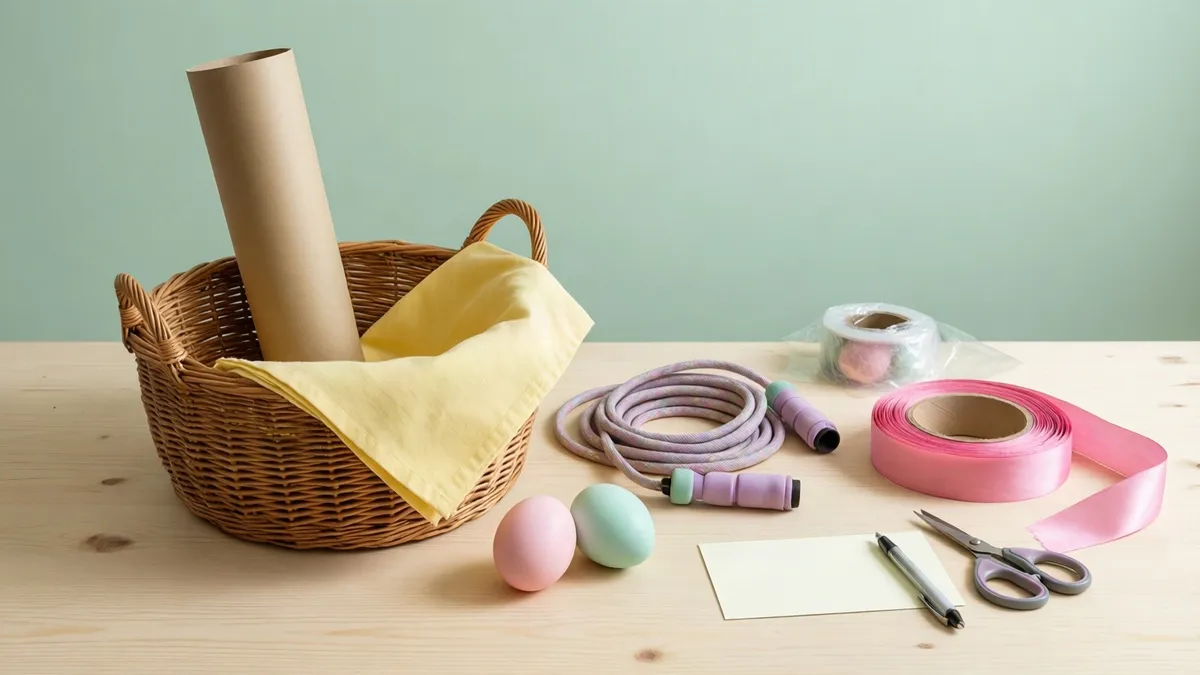
The short answer: Build in this order. Pick the vessel to the size you mean to fill, line it, and set the tall item at the back. Add the anchor, fill the gaps, and put the filler in last. The card goes on top. Most of the money lands on the container and the wrap.
We write buying guides, not lab reviews: we have not tested every product on this page. Prices, availability and ratings change constantly — whatever Amazon shows when you click is the authoritative figure.
Some links on this page are affiliate links. If you buy through one, we earn a commission — the price you pay is exactly the same. It never decides what ends up on the list. The full affiliate disclosure sets out how that works, including the Federal Trade Commission's endorsement rules at 16 CFR Part 255 that we write under.
Knowing what belongs in a basket is half the job. The other half is twenty minutes at the kitchen table with a container that turned out too big. This page is the assembly and the receipt.
How do you make an Easter basket, step by step?
The order matters more than the contents. A basket that looks thin, or tips over, or buries its best item under a layer of paper is almost always assembled in the wrong sequence. Clear a table, put everything you bought on it, and work down the eight steps below.
-
Pick the vessel to the size you intend to fill. A big basket is not generous, it is empty, and empty is what thin looks like. Lay everything out first, then pick the container it fills to the rim.
-
Line the bottom. A folded towel, a tee shirt or a cloth basket liner raises the floor two or three inches. Wicker has gaps that swallow small things, and a lining also stops the load sliding sideways when the basket is carried.
-
Set the tall thing at the back. Whatever has height goes in first, standing against the back rim: a book on its spine, a rolled towel, a boxed item. It becomes the wall everything else leans on, and adding it later means taking the basket apart.
-
Build height with the anchor. The one real gift sits front and center against that back wall. A jump rope coiled loosely takes far more space than it does flat, which is the point. Bulk in the middle is what makes a basket read as full.
-
Fill the gaps. Small things go around the edges and into the pockets between the big ones. Anything you want seen first gets tucked at an angle, facing whoever picks the basket up.
-
Filler last, once everything else is in. Paper shred is not a foundation, it is caulk. Poured in early it compresses under the weight, and you have paid for a bag of grass nobody can see. At the end, one handful covers every visible gap.
-
Wrap it, or skip it. Cellophane and a bow cost more than people expect. Cellophane basket bags earn their price on a basket that travels or waits overnight. On one carried from a closet to a kitchen table, they buy a few seconds of drama.
-
Card on top. Write it before you assemble, because afterwards you will skip it. A blank card with two handwritten lines costs the least of anything here and is likeliest to survive to next year.
How do you make two siblings' baskets feel equal?
Match the count and the container, then let the contents differ completely. Two baskets read as equal when they share a shape and hold the same number of things. They stop when one child can count more, or when one is visibly taller. Nobody compares specifications. They compare silhouettes.
- Same container, same size. Buy the pair together. A matching set of an Easter bucket in two colors settles the argument early, and the color becomes each child's own for years.
- Same number of things, not the same things. Six items and six items. A nine-year-old's six and a four-year-old's six have nothing in common, and that is fine.
- One anchor each, at roughly the same spend. That is the only line you match on money. Everything else is small enough that the gap disappears.
- Same candy, honestly. Siblings audit this layer hardest. Split one multipack evenly rather than buying two novelties.
Where ages are far apart, the older child notices spend and the younger one notices volume. A tween's anchor can be flat and expensive while a toddler's is bulky and cheap. Our Easter basket ideas by age band has the version of that trade for each one.
Where the money actually goes
More goes on the container than on anything except the anchor, and that is the part nobody plans for. The vessel, the filler and the wrap are three lines that never make it into the mental total, and together they take a large share of it.
These bands are ours, worked out for one basket at a time, and no survey backs them. (The National Retail Federation's per-person figure of $195.59 for 2026 counts the ham and the dress too.)
| Line | Planning band | How to make it smaller |
|---|---|---|
| Vessel | Under $15 new, $0 reused | Buy plain once, reuse for years |
| Filler | Under $6 | Use a towel or a tee shirt instead |
| Wrap and bow | Under $8 | Skip it unless the basket travels |
| Anchor | About half the total | One item, not six |
| Candy | Under $8 | Split one multipack across baskets |
| Keepers | Under $10 | Small by design |
Under $20 works when the container comes out of a closet and nothing goes on filler or wrap. $20 to $45 is where most of these land: a plain container you keep, one anchor worth having, a couple of keepers and something chocolate.
$50 and up buys a present with a basket around it, which is fine as long as you mean to do it again.
Can you make an Easter basket from things already in the house?
Mostly, yes. The vessel, the filler, the wrap and the card are all replaceable with things you already own. That is four of the six budget lines gone, which leaves the anchor as the only thing you have to buy.
Start with the container. Last year's basket is in a closet somewhere, and so is a mixing bowl, a beach pail, a milk crate. For the filler, a rolled bath towel does everything paper shred does and then goes back in the linen closet.
Skip the wrap and hide the basket where nobody looks: the trunk of the car, the top of a wardrobe. Write the card on whatever paper is in the house. That leaves one purchase, which is easy to get right. Buy the anchor.
When should you buy each part of the basket?
Buy in the order things spoil. A basket is a physical object whose parts queue, melt, flatten or sell out, and each of those carries its own lead time. The table runs from the longest lead to the shortest, counted backwards from Easter morning. The weeks in it are our planning numbers rather than published deadlines; the only date below with a standard behind it is the shipping one.
| When | What you are buying | Why it can't wait |
|---|---|---|
| Six weeks out | Personalized, embroidered or made-to-order pieces | A production queue plus transit, and neither shortens because the date moved early |
| Four weeks out | The vessel, and both vessels if there are two children | Everything else is sized to the container, so it has to be in hand first |
| Three weeks out | The anchor | The one item you would hate to swap for whatever is still on the shelf |
| Ten days out, if it ships | The box, the padding and the postage | Ground service wants about a week of runway, and rushed parcels get packed badly |
| One week out | Keepers, stuffers, plastic eggs | Cheap to add to an order already placed, expensive as a separate rush |
| Two days out | Candy, and chocolate above all | Soft chocolate is a warm-house problem, and a hidden basket is a warm place |
| The night before | The assembly itself | Filler compresses under weight overnight, and a built basket is impossible to hide |
Easter Sunday falls on March 28 in 2027, per the published liturgical calendar of the United States Conference of Catholic Bishops. That is early. Check where Easter lands this year before you fix any of these dates, because an early one deletes a week off the top of the table.
Building a basket for a child under three
The assembly rules hold at every age. What changes below three is the shopping, and the deciding happens at the shelf rather than at the kitchen table. The U.S. Consumer Product Safety Commission (CPSC) sets out what you are reading the box for. Our standing note covers the filler and the eggs as much as the gifts.
Read the box before it goes in the basket. Check the manufacturer's stated age grading, and check for the small-parts warning required under the CPSC's regulation at 16 CFR Part 1501 — anything that fits inside a 1.25-inch tube is treated as a choking hazard for children under three. Plastic grass and small plastic eggs fall in the same category. The call is yours to make, not ours.
What goes in an Easter basket walks through the labeling in full, including the test behind the warning and the categories the regulation exempts.
Shipping a basket you already made
Once it goes in a box, a basket is a parcel and the rules change. The fresh and the meltable come out, everything loose gets secured, and the wrap turns into packing. Often the better answer is to ship the contents flat and let the far end assemble.
The U.S. Postal Service (USPS) settles part of it. Its Publication 52 states that "fresh fruits and vegetables are nonmailable unless presented in a dry (not dried) condition." The same standard bars perishable foods that "decompose easily or cannot reach their destination without spoiling." Chocolate is mailable, but rarely intact after a warm truck.
If it ships assembled, pack it properly:
- Set the basket inside a shipping box with an inch of clearance all round, and fill that clearance.
- Tape or tie every loose item down, or it arrives as a rattling pile.
- Let the filler do packing duty, and add the wrap last.
- Leave out anything fresh, anything liquid, and anything you would not want to open at ninety degrees.
No published USPS Easter shipping deadline exists. The Postal Service issues recommended send-by dates for the December peak only, so borrow the shape of that guidance. For 2025 it recommended Ground Advantage by December 17 and Priority Mail Express by December 20, for delivery by the 25th. Call it a week of runway for ground, a few days for expedited.
FAQ
What order do you put things in an Easter basket?
Tall items first, standing against the back rim, then the anchor front and center, then small things tucked into the gaps around them. Filler goes in at the very end, pushed into the seams. Poured in early it compresses under the weight, and the basket ends up looking half empty.
How do you make an Easter basket look full without spending more?
Raise the floor and add bulk rather than more items. A folded towel under everything lifts the contents two or three inches. A coiled jump rope or a rolled tee shirt occupies far more space than it does flat. Then pick a container small enough that what you already have reaches the rim.
Do siblings' Easter baskets have to cost the same?
Totals should be close, but the contents should not match. Use identical containers, the same number of items, and one anchor each at roughly the same spend. Children compare height, item count and candy. They do not compare receipts, and buying the same thing twice wastes the older child's basket.
How far ahead can you make an Easter basket?
Buy across six weeks and put it together on Saturday evening. Personalized pieces need about a month and a half, the anchor about three weeks, candy the last couple of days. A finished basket is hard to hide and the filler flattens under its own contents, so building early costs you more than it saves.
What can you use instead of an Easter basket?
Anything with sides. A bucket, a beach pail, a colander, a canvas tote, a felt bin, a mixing bowl, a small crate. The useful test is whether it has a second job after Easter Sunday, because a container that goes straight back into the closet has cost you money and earned a shelf.
Sources
- U.S. Government Publishing Office / Consumer Product Safety Commission, "16 CFR Part 1501 — Method for Identifying Toys and Other Articles Intended for Use by Children Under 3 Years of Age Which Present Choking, Aspiration, or Ingestion Hazards Because of Small Parts" — govinfo.gov/CFR-2024-title16-vol2-part1501 (retrieved August 20, 2026)
- Federal Trade Commission, "16 CFR Part 255 — Guides Concerning Use of Endorsements and Testimonials in Advertising," the rules behind the affiliate disclosure above — govinfo.gov/CFR-2024-title16-vol1-part255 (retrieved August 20, 2026)
- United States Postal Service, "53 Fresh Foods and Other Perishables," Publication 52 — Hazardous, Restricted, and Perishable Mail — pe.usps.com/text/pub52/pub52c5_011.htm (retrieved August 20, 2026)
- United States Postal Service, "USPS Recommends 2025 Holiday Mailing and Shipping Dates," September 17, 2025; December peak only, no Easter equivalent is published — about.usps.com/newsroom/2025-holiday-mailing-dates (retrieved August 20, 2026)
- United States Conference of Catholic Bishops, "Liturgical Calendar for the Dioceses of the United States of America 2027" — usccb.org/resources/2027cal.pdf (retrieved August 20, 2026)
- National Retail Federation, "Easter Spending Expected to Reach a Record $24.9 Billion," March 24, 2026; survey with Prosper Insights & Analytics among 7,845 adults, March 2–11, 2026, margin of error ±1.1 percentage points — nrf.com/easter-spending-record (retrieved August 20, 2026)