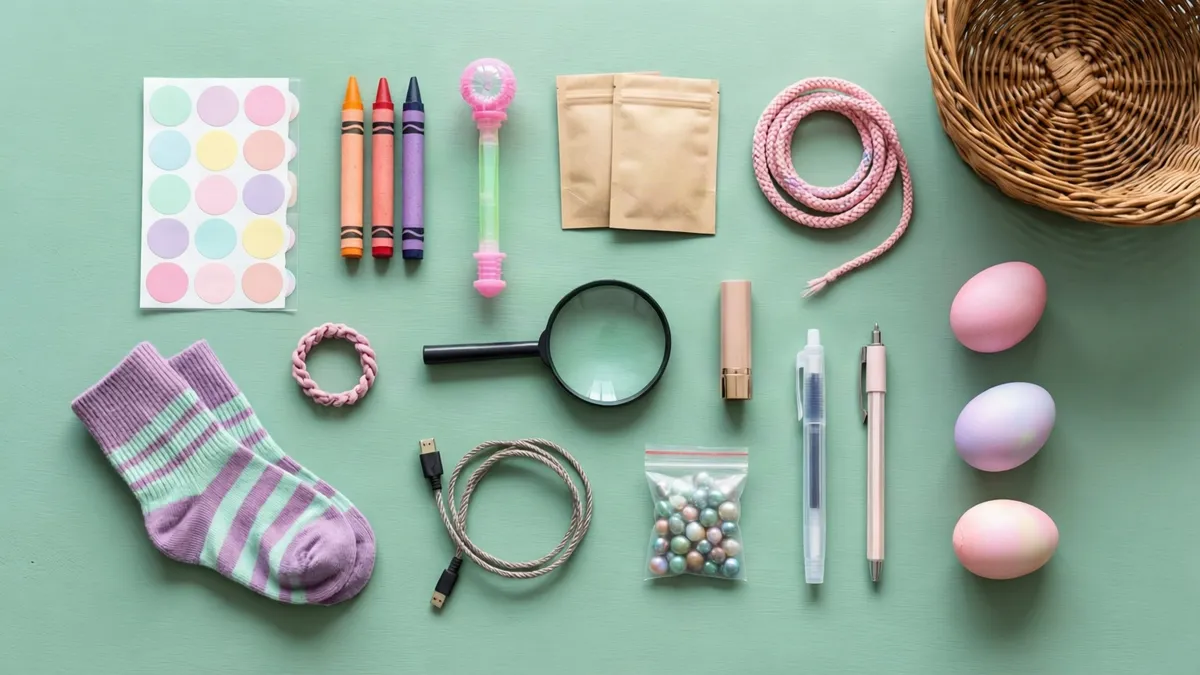
The short answer: Stuffers are the small items that fill the space around the one real gift. Eight to twelve of them finishes most baskets, by our own planning. What they are changes completely between a two-year-old and a fifteen-year-old, and below three the box decides before your taste does.
We write buying guides, not lab reviews: we have not tested every product on this page. Prices, availability and ratings change constantly — whatever Amazon shows when you click is the authoritative figure.
Some links on this page are affiliate links. If you buy through one, we earn a commission — the price you pay is exactly the same. It never decides what ends up on the list.
Our affiliate disclosure has the detail. It sits above the first link because the Federal Trade Commission's guides at 16 CFR Part 255 call for a disclosure that is "difficult to miss."
Stuffers get bought last and thought about least. That is how three dollar-aisle novelties end up in a basket that had enough already.
This page is only the small stuff. Our age-by-age basket guide covers the anchor gift these items sit around.
Easter Sunday falls on March 28, 2027, per the published liturgical calendar of the United States Conference of Catholic Bishops. Check the date first, because it moves by weeks.
| Age band | What fills the gaps | What to check before buying |
|---|---|---|
| One to two | Bath things, board books, a spoon and cup set | The age grade on the box, and the small-parts warning |
| Three to five | Stickers, crayons, bubbles, chalk, seed packets | A choking warning as well as a 3+ grade |
| Six to nine | Trading cards, gel pens, a deck of cards | Marbles and small balls, which carry their own label |
| Ten to twelve | A good pen, a cable, lip balm, a card game | Whether the house already has three of them |
| Thirteen and up | Socks, snacks, a gift card, a keychain | Whether it reads as a kid's item |
| Adult | Coffee, hot sauce, a puzzle book, kitchen things | Whether they will get to the end of it |
What goes in a basket for a one- to two-year-old?
Packaging answers this band before taste does. Below three, the box has already ruled on half your options before you pick anything up, and the first thing to read is the maker's own age grade. The U.S. Consumer Product Safety Commission (CPSC) sets out the second thing. Here is our standing note.
Read the box before it goes in the basket. Check the manufacturer's stated age grading, and check for the small-parts warning required under the CPSC's regulation at 16 CFR Part 1501 — anything that fits inside a 1.25-inch tube is treated as a choking hazard for children under three. Plastic grass and small plastic eggs fall in the same category. The call is yours to make, not ours.
What tends to fill the gaps at this age:
- Bath toys
- A board book
- A teether
- A washcloth or a bib
- A soft cloth ball
- A spoon and cup set
- A spring sun hat
- A small towel, folded flat underneath everything
Which products fall under the rule is decided partly by the package itself. The CPSC weighs "the manufacturer's stated intent (such as on a label) if it is a reasonable one." Then the marketing. Then whether the article is "commonly recognized as being intended for children under 3."
The regulation carves out a list of its own, and some basket staples are on it. It names "grooming, feeding, and hygiene products, such as diaper pins and clips, barrettes, toothbrushes, drinking glasses, dishes and eating utensils." A toddler spoon and cup set is a different sort of purchase from a toy.
A set of bath toys covers the gap between the anchor and the rim, and it gets used the same week.
Three to five, the easiest band to fill
Cheap, consumable, and used up by June: that is the brief here. It is also the easiest band to overfill, because everything on the shelf costs two dollars and the pile grows while you are not watching. Ten small things that work:
- Sticker sheets
- Chunky crayons
- Bubbles with a fat wand
- Sidewalk chalk
- Seed packets
- Character bandages
- A small watering can
- Play dough
- A foam paintbrush set
- A magnetic drawing pad
A pack of sticker sheets splits across every plastic egg you own.
Two bubble wands and a refill bottle outlast most of what else goes in.
What do six- to nine-year-olds actually keep?
Things with a use, a rule, or a set. This is the band that keeps whatever has a second session in it and drops whatever performs once, which is the whole argument against the wind-up chick. Ten that hold up:
- Trading cards from whatever they collect
- Gel pens
- A sticker-by-number book
- A friendship bracelet kit
- A magnifying glass
- A deck of cards
- Kite string
- A keychain flashlight
- A small notebook
- Temporary tattoos
A friendship bracelet kit has a Sunday afternoon in it, which this band rarely offers.
Marbles and bouncy balls are classic egg fillers, and under 16 CFR 1500.19 a toy containing either one carries a cautionary statement up to age eight. Read which box you have.
Gel pens sit at a kitchen table and get used for months.
Stuffers for ten to twelve, the band that notices
Nothing cutesy, and nothing branded to the holiday. What lands at this age is the ordinary object they already carry around in a bag or a pocket, bought in a slightly better version than the one they own. Ten of them:
- A good pen
- A charging cable
- A phone grip
- A laptop or case sticker
- Lip balm
- A card game
- Claw clips or hair ties
- Gum
- A small hobby consumable
- A keychain
A lip balm set is the sleeper item: small, cheap, and the sort of thing a ten-year-old puts in a bag and keeps.
Hobby consumables need one fact from February: skate hardware, sketchbook refills, a card-game booster, a brand of guitar picks. Ask once, write it down.
What do you put in a teen's basket?
Ordinary things they use, bought in the version they would pick. Socks, a charging cable, the snack they actually eat, a gift card, small skincare, a keychain, a water bottle sticker, an earbud case, hand cream, and gum. Nobody writes stuffer lists for this band, which is why the aisle is useless to you.
Cables are the most reliable item on that list. A USB-C charging cable longer than the one that came in the box is genuinely wanted and reads as thoughtful.
Buy the thing they named rather than the category it belongs to, and keep the pastel out of it.
Small fillers for an adult basket
Consumables, mostly, because adults keep less and eat more than any of the bands above. Good coffee, a hot sauce, a puzzle book, seed packets, flaky salt. Then a citrus zester, a bench scraper, wool socks, a nice notepad, and one bar of the chocolate they would never buy themselves.
A hot sauce sampler is the version of a candy layer that a forty-year-old is actually pleased about.
A puzzle book plus a decent pen is a two-item basket that gets finished, and the chocolate should be solid.
How many stuffers does a basket need?
Eight to twelve small items, plus the anchor. That is our own planning number rather than a surveyed one, and it holds at every band above. Buying past twelve rarely helps, because a basket looks finished when the contents match the size of the container.
So pick the container to the pile you already have. One two sizes too big swallows whatever you add.
For the stuffers alone we plan on $10 to $20 for the set, on top of the anchor. That band is our editorial judgment. No survey backs it.
Gaps are also made during assembly: tall items at the back, bulk in the middle, small things wedged into the pockets between. Our step-by-step build covers that order.
The stuffers that are a mistake
Four categories, and they are the four the March aisle is built from. The novelty that breaks by Tuesday. The light-up thing with a coin battery. The plastic egg counted as a gift. And anything the house already has three of.
The one-day novelty. Spinners, blow-outs, poppers, wind-up chicks. Two dollars, one morning, and the reason a basket is picked over within days.
Anything with a button cell or coin battery. Coin cells carry a federal rule of their own. The requirement under 16 CFR Part 1263 is to "prevent child access to batteries during reasonably foreseeable use and misuse."
Two recalls show what that looks like in a basket. In August 2026 the CPSC recalled about 25,200 Easter LED headbands under recall 26662. The lithium coin batteries "can be accessed easily by children, posing an ingestion hazard."
Recall 17166 covered about 43,400 light-up Easter spinners in 2017, because "the battery cover can detach and expose the small coin cell batteries." Both failed at the same component. Turn the package over.
The plastic egg as an item. An egg is a wrapper. Fill each one with something that would have earned its place anyway and it works. Fill twelve with jelly beans and one plastic ring, and the count is one.
The duplicate. Grandparents build baskets too, and so does the other household. One phone call in February sorts it out.
Non-candy and allergen-aware stuffers
Non-food stuffers avoid the question, which is why they are the default for anything leaving your house. Ten that work in a classroom basket: stickers, pencils, bookmarks, erasers, bubbles, hair ties, small notebooks, temporary tattoos, seed packets, and a keychain.
When food is in a shared basket, here is our standing note.
If the basket is going to a classroom, a group hunt or a child who is not your own, treat peanuts and tree nuts as a real constraint: check the label for the allergen statement required by U.S. food labeling rules, and ask the parent or the teacher before you assume. We are not qualified to tell you what is safe for a particular child.
Where to look: the wrapper carries the declaration, inside the ingredient list or in a "contains" line beside it. The U.S. Food and Drug Administration (FDA) names peanuts and tree nuts among the nine major food allergens. Then ask the teacher. What goes in an Easter basket has the labeling detail.
There is a plain case for more non-food in the basket, too. In the National Retail Federation's (NRF) 2026 Easter survey, 92% of shoppers said they were buying candy, against 64% buying gifts. A stuffer list is the cheapest place to lean the other way.
FAQ
What are Easter basket stuffers?
Stuffers are the small, low-cost items that fill the space around the main gift — stickers, pens, socks, bath toys, snacks, a keychain. They are neither the anchor nor the container. Their job is to make the basket read as finished.
How many stuffers go in an Easter basket?
Eight to twelve, plus one anchor item, and $10 to $20 for the set. Both figures are our own planning numbers. The better guide is the container: choose one your pile fills to the rim, because a thin-looking basket is usually one bought too large.
What are good non-candy Easter basket stuffers?
Stickers, pencils, bookmarks, erasers, bubbles, hair ties, small notebooks, temporary tattoos, seed packets, and keychains. None carry a food label to check, which makes them the straightforward option for a classroom basket or a child whose household you barely know.
What stuffers should you avoid for a toddler?
Read the package rather than a list. Check the manufacturer's stated age grading and the small-parts warning required under 16 CFR Part 1501, which treats anything fitting inside a 1.25-inch tube as a choking hazard below three. Plastic grass and small eggs sit there too.
What can you put in plastic Easter eggs?
Whatever would have earned a spot in the basket anyway: stickers, hair ties, coins, a folded note, a trading card, a character bandage. Count the contents, not the eggs. A dozen eggs holding one real thing is a bag of packaging.
Sources
- U.S. Government Publishing Office / Consumer Product Safety Commission, "16 CFR Part 1501 — Method for Identifying Toys and Other Articles Intended for Use by Children Under 3 Years of Age Which Present Choking, Aspiration, or Ingestion Hazards Because of Small Parts" — govinfo.gov/CFR-2024-title16-vol2-part1501 (retrieved August 20, 2026)
- U.S. Government Publishing Office / Consumer Product Safety Commission, "§ 1500.19 Misbranded toys and other articles intended for use by children" — govinfo.gov/CFR-2024-title16-vol2-sec1500-19 (retrieved August 20, 2026)
- U.S. Government Publishing Office / Consumer Product Safety Commission, "16 CFR Part 1263 — Safety Standard for Button Cell or Coin Batteries and Consumer Products Containing Such Batteries" — govinfo.gov/CFR-2024-title16-vol2-part1263 (retrieved August 20, 2026)
- Federal Trade Commission, "16 CFR Part 255 — Guides Concerning Use of Endorsements and Testimonials in Advertising," the rules behind the affiliate disclosure above — govinfo.gov/CFR-2024-title16-vol1-part255 (retrieved August 20, 2026)
- U.S. Consumer Product Safety Commission, "OKK Trading Recalls Easter LED Headbands Due to Risk of Serious Injury or Death from Battery Ingestion; Violate Mandatory Standard for Toys," recall 26662, August 6, 2026 — cpsc.gov/Recalls/2026/OKK-Trading-Recalls-Easter-LED-Headbands (retrieved August 20, 2026)
- U.S. Consumer Product Safety Commission, "Hobby Lobby Recalls Easter and July 4th Light-Up Spinner Toys Due to Choking and Ingestion Hazards," recall 17166, May 23, 2017 — cpsc.gov/Recalls/2017/Hobby-Lobby-Recalls-Easter-and-July-4th-Light-Up-Spinner-Toys (retrieved August 20, 2026)
- U.S. Food and Drug Administration, "Food Allergies: What You Need to Know," content current as of August 16, 2024 — fda.gov/food/food-allergies-what-you-need-know (retrieved August 20, 2026)
- United States Conference of Catholic Bishops, "Liturgical Calendar for the Dioceses of the United States of America 2027" — usccb.org/resources/2027cal.pdf (retrieved August 20, 2026)
- National Retail Federation, "Easter Spending Expected to Reach a Record $24.9 Billion," March 24, 2026; survey with Prosper Insights & Analytics among 7,845 adults, March 2–11, 2026, margin of error ±1.1 percentage points — nrf.com/easter-spending-record (retrieved August 20, 2026)