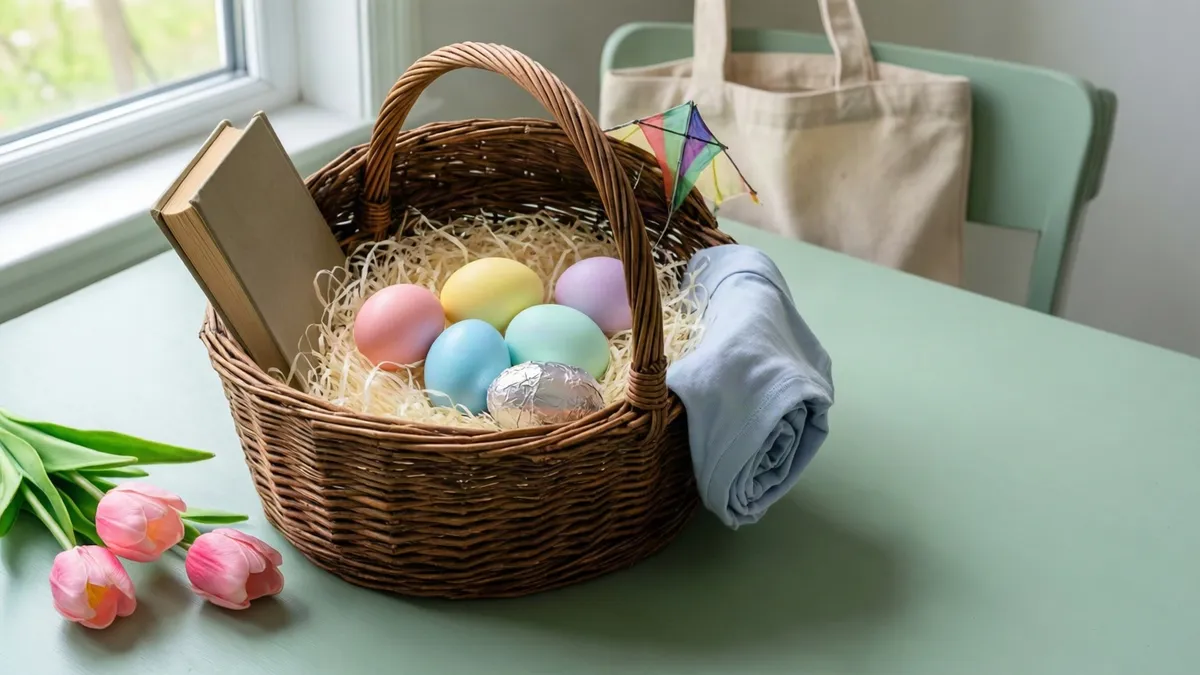
The short answer: An Easter basket is five layers — a vessel, a filler, one anchor item, a candy layer, and one or two keepers. Build them in that order and the basket works at any age and any budget. The contents change every year. The formula does not.
We write buying guides, not lab reviews: we have not tested every product on this page. Prices, availability and ratings change constantly — whatever Amazon shows when you click is the authoritative figure.
Some links on this page are affiliate links. If you buy through one, we earn a commission — the price you pay is exactly the same. It never decides what ends up on the list. The full affiliate disclosure sets out how that works, including the endorsement rules we work under.
Most Easter lists hand you forty products and no method. Learn the method once and the products sort themselves.
Easter is a religious holiday for many of the families reading this and a spring tradition for others; the basket belongs to both.
| Layer | What it does | Where the money should go |
|---|---|---|
| Vessel | Holds it and gets reused | Buy once, reuse for years |
| Filler | Lifts the contents | As close to nothing as possible |
| Anchor | The one item they remember in May | Roughly half the basket |
| Candy | The tradition, at a volume you choose | Small, if you buy the multipack |
| Keepers | One or two things still in the house in June | Small |
Two of those five layers are traps. The vessel and the filler are where the budget quietly goes, and neither of them is a gift.
Layer one: the Easter basket vessel, and why it is not the cheap part
The vessel is the container, and it is the layer people underestimate. A basket, a bag of grass, a sheet of cellophane and a bow can absorb fifteen dollars before a single gift goes in. Buy it once, buy it plain, and it comes back every spring.
Three shapes do the job. Traditional wicker photographs the way you want it to. A bucket survives an outdoor hunt and becomes a beach pail in July. A canvas tote or a felt bin ends up the child's own object by summer, which is the version I reach for.
The rule underneath all three: the container should have a second job. A vessel that holds one morning's candy and then goes in a closet is a decoration you paid for.
Starting from nothing, a plain wicker basket with no character on the front will outlast every themed version beside it.
And the container is not automatically the harmless part. In 2014 the U.S. Consumer Product Safety Commission (CPSC) recalled about 24,200 felt Easter baskets under recall 14181. The stated reason: "decorative beads on the felt Easter baskets can detach and pose a choking hazard to young children."
Layer two: filler, and is plastic Easter grass worth it?
Our answer is no. Filler exists to lift the contents so nothing disappears at the bottom, and plastic grass does that badly. It sheds through the house until June, it is single-use, and for a basket aimed at a child under three it belongs to the small-parts conversation below.
Paper shred does the identical job and goes in the recycling on Monday. A bag of paper shred in one color reads cleaner in photos than the multicolor plastic stuff anyway.
Better still, make the filler a gift:
- A folded tea towel or a receiving blanket for the youngest bands, where you want to see through the layer.
- A beach towel for elementary ages, bought two months early.
- A T-shirt rolled along the bottom, which lifts the contents and counts as an item.
Each of those does the lifting and then gets kept, which removes a line from the budget.
Plastic eggs are the other half of the fill question, and they are not neutral filler. Fill them with the small non-food things that already earn their place — stickers, hair ties, coins, a folded note — and treat the empty ones as packaging rather than as items. For a basket aimed at a child under three, the standing note below covers them the same way it covers the grass.
Layer three: the anchor item, and why one beats six
The anchor is the single item the basket is built around, and it should take roughly half of what you plan to spend. Six small items make a pile; one right item makes a gift.
The test is simple. Will it still be in use in June? A kite, a jump rope, a bug jar, a hobby item they have named out loud, a book in a series they are halfway through. A blowing, spinning, light-up novelty does not pass.
A kids kite is a good default for the middle bands, because you are shopping two months ahead of real spring weather.
Which anchor depends on who the basket is for. The layers hold at every age; only what sits inside them moves.
| Age band | Anchor that tends to land | Keeper that survives |
|---|---|---|
| One to two | A board book or a stacking set | A hooded towel |
| Three to five | Sidewalk chalk or bubbles | A cup they choose themselves |
| Six to nine | A kite, a jump rope, a bug jar | A water bottle |
| Ten to twelve | A hobby item they have named | A deck of cards |
| Thirteen and up | Something for a bag, a desk or a sport | A good pen |
| Adult | One nice thing they would not buy twice | A book |
Read the manufacturer's stated age grading on anything going to the first two bands. Our age-by-age Easter basket guide works through each one properly, including the tween band everybody else skips.
Layer four: how much candy actually belongs in there?
Less than most baskets carry. In the National Retail Federation's (NRF) 2026 Easter survey, candy was the most-purchased category at 92%, while gifts sat at 64%. That survey ran with Prosper Insights & Analytics among 7,845 adults, fielded March 2 to 11, 2026. The gap is worth correcting.
One good chocolate item plus one non-chocolate item is a complete candy layer for most bands. Buy solid over hollow; hollow is mostly air and arrives broken. Buy the bagged multipack rather than the single-serve novelty, in the last week.
Cost is moving, too. Calculated from published U.S. Bureau of Labor Statistics Consumer Price Index values for candy and chewing gum, prices rose 10.6% between March 2025 and March 2026. They are up 51.6% since March 2019. That is candy generally, not the price of a basket.
One Easter candy multipack split across two or three baskets costs less than a novelty item each, and looks like more.
Every basket here has a no-candy version. Delete layer four, promote a second keeper, and the structure holds.
If the basket is leaving your own house, the calculation changes:
If the basket is going to a classroom, a group hunt or a child who is not your own, treat peanuts and tree nuts as a real constraint: check the label for the allergen statement required by U.S. food labeling rules, and ask the parent or the teacher before you assume. We are not qualified to tell you what is safe for a particular child.
What the label must carry is federal rule, so you can read it with confidence. The U.S. Food and Drug Administration (FDA) lists the major food allergens as milk, eggs, fish, Crustacean shellfish, tree nuts, peanuts, wheat, soybeans and sesame. The declaration appears either in parentheses in the ingredient list, as in "lecithin (soy)," or in a "contains" statement beside it.
Two limits travel with that. Advisory lines such as "may contain" are, in the FDA's words, "not required by law." And a fun-size wrapper tipped loose into a basket may not be the one that carried the label. Non-food fillers sidestep the question: stickers, pencils, bookmarks, bubbles, notebooks.
Layer five: the keepers, or what survives to June
Keepers are the one or two small things still in the house months later, and they separate a basket from a snack delivery. They are cheap by design. The anchor carries the budget; the keepers carry the memory of it.
Reliable ones at nearly every age: a book, a water bottle, seed packets and a small pot, a deck of cards, a good pen.
A kids water bottle is the least glamorous item on that list and the one most likely to be in daily use in September. A children's paperback in a series they already read beats a standalone title every time.
The cheapest keeper costs nothing. Write the card. Children keep the card long after they have forgotten which year the chocolate rabbit came from.
What does an Easter basket actually cost?
More than people plan for, because the container and the filler are rarely in the estimate. One figure gets misquoted every spring. The same NRF release put per-person Easter spending at $195.59, but that covers food, clothing, flowers, decorations and gifts combined. It is not a basket budget.
The bands below are our editorial judgment, not a sourced figure. They assume one basket, and most households multiply by the number of children.
Under $20. Reuse last year's vessel, skip bought filler entirely, and put the whole amount into one anchor plus a candy item. This basket looks thin only if you buy filler to pad it.
$20 to $45. The working band for most households. A plain reusable container, one real anchor, two keepers, one candy item. This is where the formula earns its keep.
$50 and up. Here you are buying a gift and dressing it as a basket. Watch the precedent: build a $90 basket this year and next year starts at $90.
Whatever the band, the split matters more than the total. Half to the anchor, as little as possible to the vessel and filler, the remainder across candy and keepers.
What should you check on the box for a child under three?
The packaging, before anything else. Below three this stops being a matter of taste and becomes a question of what the manufacturer printed. Here is our standing note.
Read the box before it goes in the basket. Check the manufacturer's stated age grading, and check for the small-parts warning required under the CPSC's regulation at 16 CFR Part 1501 — anything that fits inside a 1.25-inch tube is treated as a choking hazard for children under three. Plastic grass and small plastic eggs fall in the same category. The call is yours to make, not ours.
The test behind the warning is mechanical. The item goes into a 1.25-inch cylinder uncompressed, and in the CPSC's own wording, if it "fits entirely within the cylinder, in any orientation, it fails to comply." That is the whole rule, and you can picture it while you are holding the box.
Some basket staples sit outside it. The regulation exempts books and paper, crayons and chalk, clothing, modeling clay, paint sets, rattles, pacifiers and balloons. Exempt from a regulation is not the same as right for your child, so the box still gets read.
One label confuses everybody. Under 16 CFR 1500.19, a toy for children at least three but under six carries the word "WARNING" and the phrase "CHOKING HAZARD" when it holds a small part. Small balls and marbles carry their own statements, which run up to age eight. So a 3+ box and a 6+ box say different things. Check which one you are holding.
Batteries are their own federal rule. 16 CFR Part 1263, made under Reese's Law, sets requirements meant to "prevent child access to batteries during reasonably foreseeable use and misuse." The CPSC recalled about 25,200 Easter LED headbands in August 2026 under recall 26662, stating the lithium coin batteries "can be accessed easily by children, posing an ingestion hazard."
Keep the scale honest, though. Easter-branded choking and ingestion recalls are rare, and the two above are the kind of thing that turns up when they happen. It happens, those are the real cases, and the instruction stays the same. Read the box.
When should you start building, and in what order?
Start from the date, because the date moves. The U.S. Naval Observatory states the rule: Easter is "the first Sunday following the first ecclesiastical full moon that occurs on or after the day of the vernal equinox." It "can never occur before March 22 or later than April 25."
Those bounds are not theoretical. Per the published liturgical calendars of the United States Conference of Catholic Bishops (USCCB), Easter Sunday falls on March 28 in 2027 and April 16 in 2028. Nineteen days apart, in consecutive years. Why the date moves, and where it lands through 2032 has the full table.
Then build in layer order, because the lead times differ:
- Vessel first, four weeks out. Anything personalized or made to order queues, and it is the first casualty of a lost week.
- Anchor second, two to three weeks out. The item you least want to substitute late.
- Keepers third. Small, widely stocked, easy to add to the anchor order.
- Filler fourth, if at all. A towel you already own makes this step free.
- Candy last, in the final week. Chocolate left in a warm car is a lost item.
Assemble the night before, and hide the shopping bags.
FAQ
What are the five layers of an Easter basket?
A vessel, a filler, one anchor item, a candy layer, and one or two keepers. The vessel holds and gets reused, the filler lifts the contents, the anchor takes about half the budget, and the keepers are the small things still around in June.
How much candy should go in an Easter basket?
One good chocolate item and one non-chocolate item covers most baskets. Buy solid over hollow, and buy the bagged multipack rather than single-serve novelties. In the National Retail Federation's 2026 Easter survey, candy was the most-purchased category at 92%, against 64% for gifts. Most baskets skew heavy.
What can you use instead of plastic Easter grass?
Paper shred is the direct swap, and it recycles. Better options double as gifts: a folded tea towel, a receiving blanket, a beach towel bought ahead of summer, or a rolled T-shirt. For a child under three, our note on small parts covers grass and small plastic eggs alike.
What should the anchor item be?
Whatever passes one test: will it still be in use in June? A kite, a jump rope, a bug jar, a book in a series they are mid-way through, or a hobby they have named. It should take roughly half the budget, because one good item outlasts six cheap ones.
How many items should be in an Easter basket?
Five to eight is plenty, counting the anchor and the candy. Item count is the wrong target: a basket of twelve novelties reads as full on Sunday and is gone by Wednesday. Volume comes from the vessel size, so pick a container you actually intend to fill.
Sources
- U.S. Government Publishing Office / Consumer Product Safety Commission, "16 CFR Part 1501 — Method for Identifying Toys and Other Articles Intended for Use by Children Under 3 Years of Age Which Present Choking, Aspiration, or Ingestion Hazards Because of Small Parts" — govinfo.gov/CFR-2024-title16-vol2-part1501 (retrieved August 20, 2026)
- U.S. Government Publishing Office / Consumer Product Safety Commission, "§ 1500.19 Misbranded toys and other articles intended for use by children" — govinfo.gov/CFR-2024-title16-vol2-sec1500-19 (retrieved August 20, 2026)
- U.S. Government Publishing Office / Consumer Product Safety Commission, "16 CFR Part 1263 — Safety Standard for Button Cell or Coin Batteries and Consumer Products Containing Such Batteries" — govinfo.gov/CFR-2024-title16-vol2-part1263 (retrieved August 20, 2026)
- Federal Trade Commission, "16 CFR Part 255 — Guides Concerning Use of Endorsements and Testimonials in Advertising," the rules behind the affiliate disclosure above — govinfo.gov/CFR-2024-title16-vol1-part255 (retrieved August 20, 2026)
- U.S. Consumer Product Safety Commission, "Nantucket Distributing Recalls Felt Easter Baskets Due to Choking Hazard," recall 14181, May 15, 2014 — cpsc.gov/Recalls/2014/Nantucket-Distributing-Recalls-Felt-Easter-Baskets (retrieved August 20, 2026)
- U.S. Consumer Product Safety Commission, "OKK Trading Recalls Easter LED Headbands Due to Risk of Serious Injury or Death from Battery Ingestion; Violate Mandatory Standard for Toys," recall 26662, August 6, 2026 — cpsc.gov/Recalls/2026/OKK-Trading-Recalls-Easter-LED-Headbands (retrieved August 20, 2026)
- U.S. Food and Drug Administration, "Food Allergies," content current as of March 11, 2026 — fda.gov/food/food-allergies (retrieved August 20, 2026)
- U.S. Food and Drug Administration, "Food Allergies: What You Need to Know," content current as of August 16, 2024 — fda.gov/food/food-allergies-what-you-need-know (retrieved August 20, 2026)
- U.S. Naval Observatory, Astronomical Applications Department, "Easter" — aa.usno.navy.mil/faq/easter (retrieved August 20, 2026)
- United States Conference of Catholic Bishops, "Liturgical Calendar for the Dioceses of the United States of America 2027" — usccb.org/resources/2027cal.pdf (retrieved August 20, 2026)
- United States Conference of Catholic Bishops, "Liturgical Calendar for the Dioceses of the United States of America 2028" — usccb.org/resources/2028cal.pdf (retrieved August 20, 2026)
- U.S. Bureau of Labor Statistics, Consumer Price Index series CUUR0000SEFR02, "Candy and chewing gum in U.S. city average, all urban consumers, not seasonally adjusted"; percentage changes calculated from published index values (149.801 in March 2019; 205.387 in March 2025; 227.059 in March 2026) — data.bls.gov/timeseries/CUUR0000SEFR02 (retrieved August 20, 2026)
- National Retail Federation, "Easter Spending Expected to Reach a Record $24.9 Billion," March 24, 2026; survey with Prosper Insights & Analytics among 7,845 adults, March 2–11, 2026, margin of error ±1.1 percentage points — nrf.com/easter-spending-record (retrieved August 20, 2026)